
Every year, technology gets smarter — but the rumors get louder. From viral posts claiming AI has feelings to friends warning you about “dangerous” phone radiation, digital myths have become the new small talk of the internet age.
The problem? Most of them sound believable.
We scroll, share, and repeat them without realizing how these stories shape our understanding of innovation itself. That’s why it’s time to pause and separate fact from fiction.
In this piece, we’ll unpack the biggest tech myths 2025 has kept alive — exploring where they come from, why they persist, and what the truth really looks like in an age of information overload.
Why Tech Myths Still Thrive in 2025
Despite living in an age where information travels at light speed, misinformation somehow travels faster. In 2025, the line between tech education and tech entertainment has blurred — and that’s where common tech myths thrive. Social media algorithms reward emotional content, not accurate content. A dramatic tweet about AI replacing jobs or your phone “listening to you” is more clickable than a calm, factual explanation.
This dynamic fuels a constant loop of confusion, even among the tech-savvy. The more advanced our tools become, the easier it is to misunderstand them. Studies from digital research firms in 2025 reveal that nearly 68% of online users admit to believing or sharing at least one false tech claim in the past year.
At Techsensi, we see tech myths 2025 not just as curiosities, but as cautionary tales — proof that knowledge doesn’t always equal understanding. By exposing the tech myths you still believe, we aim to spark a mindset shift: one where skepticism becomes a skill, and curiosity leads to truth instead of confusion.
Read More: South Korea to Build Nuclear-Powered Submarines with US Approval, Says Trump
Debunking the Biggest Tech Myths of 2025
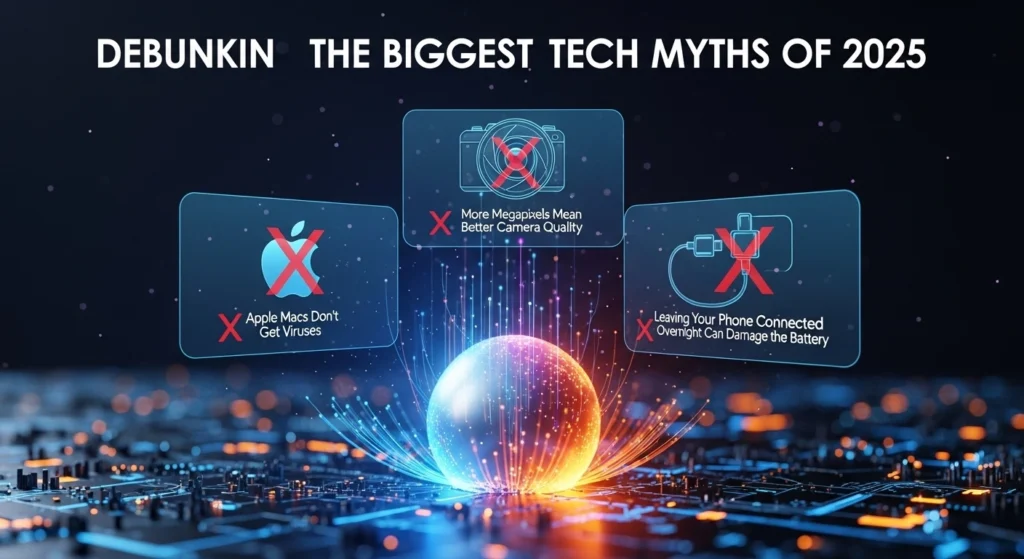
1. Apple Macs Don’t Get Viruses
Why people believe it: For years, Apple marketed Macs as “safer” alternatives to Windows PCs, and for a long time, that was statistically true — there were fewer attacks because fewer people used Macs.
The truth: In 2025, that advantage no longer exists. Cybercriminals now target macOS and iOS systems more than ever as Apple’s market share grows. Macs can get malware, phishing attempts, and adware just like any other system. Keeping your software updated and using reliable security tools is the only real protection.
Takeaway: Safety through obscurity is outdated — vigilance is the new antivirus.
2. More Megapixels Mean Better Camera Quality
Why people believe it: It’s easy to assume that bigger numbers equal better performance. Phone makers often highlight megapixels as a quick, marketable metric.
The truth: Camera quality depends more on sensor size, lens quality, and image processing algorithms than on megapixel count alone. A 12MP camera with a large sensor will outperform a 108MP sensor crammed into a small smartphone lens.
Takeaway: Don’t chase numbers — chase light, optics, and software optimization.
3. Leaving Your Phone Connected in Overnight Can Damage the Battery
Why people believe it? Overcharging is a long-standing issue with older smartphone batteries.
The truth: When a mobile phone’s battery gets 100% capacity, its sophisticated charging circuits shut down. Heat and constant full-to-empty cycles, rather than extended charging, are the primary drivers of battery degeneration.
Takeaway: Charge while sleeping, but don’t use cheap, unauthorised adapters.
4. Incognito Mode Makes You Anonymous Online
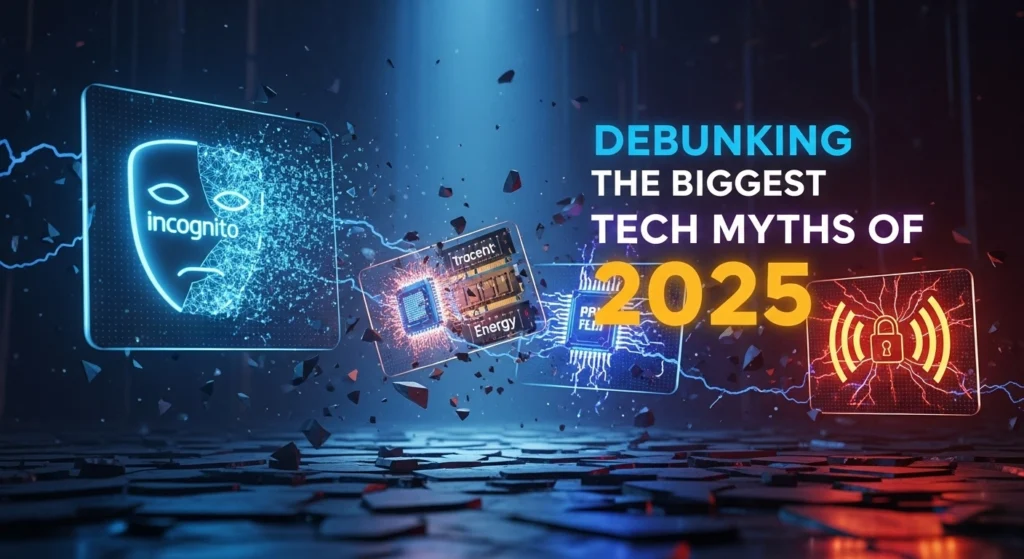
Why people believe it: The “private” icon and language suggest invisibility, creating a false sense of digital freedom.
The truth: Incognito mode only hides browsing activity from your local device — not from your internet service provider, employer, or websites you visit. Cookies and IP addresses still track you.
Takeaway: For real privacy, use encrypted browsers, VPNs, or privacy-focused search engines — not wishful thinking.
5. More RAM or More Cores Always Means a Faster Device
Why people believe it: Specs look impressive on paper, and more of anything feels like an upgrade.
The truth: Performance depends on how efficiently a system uses those resources. A well-optimized 8GB laptop can outperform a poorly managed 16GB one. The same goes for CPU cores — software must actually support multi-core performance.
Takeaway: Balance is power — not excess. Optimization beats overcompensation.
Read More: AI Platform: Nebius Token Factory vs Microsoft
6. Public WiFi Is Safe If It Requires a Password
Why people believe it: Password protection feels like a digital safety net.
The truth: Even “secured” WiFi in cafes, airports, or hotels can expose you to man-in-the-middle attacks or data sniffing. Passwords only limit access, not surveillance.
Takeaway: Avoid online banking or sharing sensitive info over public networks — use a VPN if you must connect.
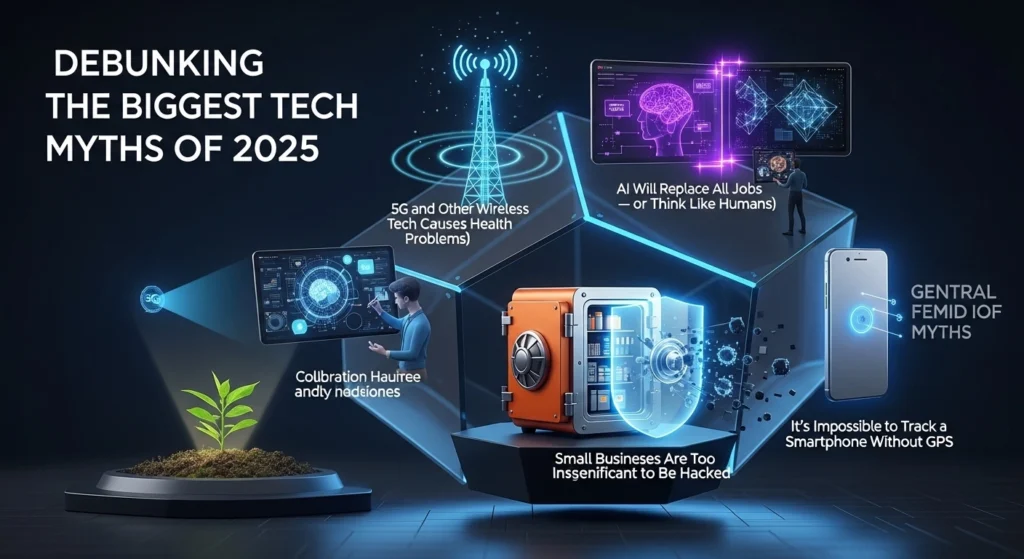
7. 5G and Other Wireless Tech Causes Health Problems
Why people believe it: Fear of radiation has followed every wireless upgrade — from microwaves to WiFi. Conspiracy theories thrive in times of rapid tech change.
The truth: 5G uses non-ionizing radiation, which means it cannot damage DNA or cause illness. Global health organizations, including the WHO, have repeatedly confirmed that 5G is safe within regulated limits.
Takeaway: 5G won’t fry your brain — but misinformation might.
8. AI Will Replace All Jobs — or Think Like Humans
Why people believe it: The media loves extremes — “AI apocalypse” headlines generate clicks and fear sells.
The truth: AI automates tasks, not entire jobs. It lacks consciousness, empathy, and human judgment. In 2025, industries are shifting toward human–AI collaboration, where tools enhance rather than erase roles.
Takeaway: The future isn’t human vs. machine — it’s human + machine.
9. Small Businesses Are Too Insignificant to Be Hacked
Why people believe it: Hackers are imagined as masterminds chasing billion-dollar corporations, not small-town stores.
The truth: In reality, small businesses are prime targets because they often lack robust security. Ransomware and phishing attacks exploit this weakness — and recovery costs can be devastating.
Takeaway: Cybersecurity is an investment, not a luxury — especially for smaller teams.
10. It’s Impossible to Track a Smartphone Without GPS
Why people believe it: GPS feels like the only system tied to location, so turning it off seems like cutting the cord.
The truth: Phones can be tracked using cell towers, WiFi signals, and even Bluetooth pings. Apps, carriers, and devices still log approximate locations without GPS.
Takeaway: If privacy matters, review app permissions, disable unnecessary connections, and use airplane mode when needed.
Read More: Top AI Productivity Tools to Supercharge Your Workflow
Breaking Free from the Tech Myths You Still Believe
The real challenge of 2025 isn’t technology itself — it’s learning to see through the noise that surrounds it. The common tech myths we explored today show how easily outdated beliefs and viral rumors can distort our understanding of innovation.
From fears about 5G and AI to blind trust in “Mac invincibility,” these stories persist because they’re simple, emotional, and familiar.
But the truth is more interesting than the myth. Understanding the facts behind the tech myths 2025 exposes isn’t just about being right — it’s about being informed, adaptable, and digitally aware in a world where every click can rewrite perception.
So next time you encounter one of the tech myths you still believe, pause before you share. Ask questions. Look deeper. Because curiosity, not fear, is what truly drives progress.
READ MORE: The Great Layoff Mystery 2025: Is “AI Washing” the Real Story Behind AI Layoffs?


One thought on “Exposing the Biggest Tech Myths 2025 You Still Believe Today”